In this exercise, find a quote that illustrates the goal of social change. Using just a sentence or two from the quote, create a graphic that captures the essence of your chosen quote. You can use any materials to design your graphic, such as paper, pens, markers, Photoshop, or Illustrator—it’s entirely up to you.
You may choose your own dimensions for this project. You could do a banner, a Poster (2’x3′ or 3’x2′), Standard letter (8.5″x11″), or a postcard. These are just a few suggestions.
Complete one layout. Please use Illustrator and Photoshop as your primary tools.
Please Include:
The Quote and the attribution
Strong visuals (Photography/illustration etc..)
A good use of Typography.
What is the point of this assignment?
To create powerful “posters” for social change that illustrate your design ability. Use all of the skills learned in prior design classes to complete this assignment. (Remember the
20 Quotes to Keep You Inspired and Committed to Social Change
Guest, I. (2024). 20 Quotes to Keep You Inspired and Committed to Social Change. Retrieved from https://www.idealist.org/en/careers/20-quotes-inspire-and-committ-to-social-change
Staying motivated in the face of social challenges can be difficult, but sometimes all it takes is the right words to rekindle your passion. Whether you’re on the frontlines of activism, pursuing a career in social impact, or quietly contributing to your community, maintaining a sense of purpose is essential. To help keep you inspired and dedicated to social change, we’ve gathered 20 powerful quotes from leaders, activists, and changemakers who have made a lasting impact on the world. Let these words remind you of the difference you can make!
If you’re working on the frontlines of activism, pursuing a social-impact career, or making quiet contributions to your community, maintaining a sense of purpose is crucial. To help you stay inspired and committed to social change, we’ve gathered 20 powerful quotes from leaders, activists, and changemakers who have left an enduring impact on the world. Let these words serve as a reminder of the difference you can make!
The importance of taking action

“Everybody can be great…because anybody can serve. You don’t have to have a college degree to serve. You don’t have to make your subject and verb agree to serve. You only need a heart full of grace. A soul generated by love.” -Martin Luther King, Jr.
“To serve is beautiful, but only if it is done with joy and a whole heart and a free mind.” -Pearl S. Buck
“You never change things by fighting the existing reality. To change something, build a new model that makes the existing model obsolete.” -Richard Buckminster Fuller
“It is not enough to be compassionate – you must act.” -The Dalai Lama
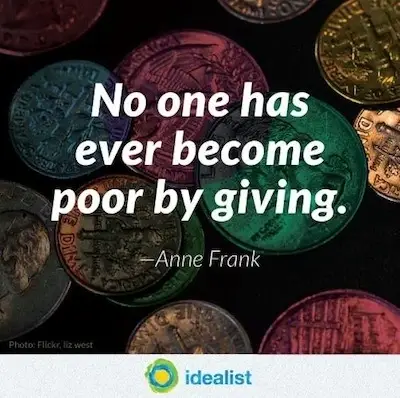
“The best way to find yourself is to lose yourself in the service of others.” –Gandhi
“We make a living by what we get, but we make a life by what we give.” -Winston Churchill
“Act as if what you do makes a difference. It does.” -William James
“The willingness to share does not make one charitable; it makes one free.” -Robert Brault
The power of small steps
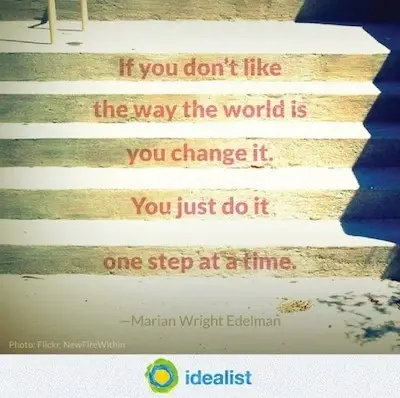
“The world changes according to the way people see it, and if you can alter, even by a millimeter, the way people look at reality, then you can change the world.” -James Baldwin
“Never doubt that a small group of thoughtful, committed citizens can change the world; indeed, it’s the only thing that ever has.” -Margaret Mead
“One person with passion is better than forty people merely interested.” -E.M. Forster
“No act of kindness, however small, is ever wasted.” –Aesop
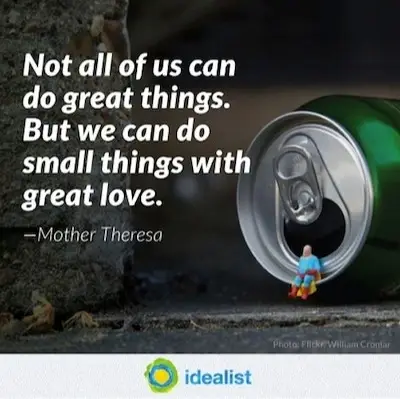
“Do what you can, with what you have, where you are.” -Theodore Roosevelt
“I wish to do something Great and Wonderful, but I must start by doing the little things like they were Great and Wonderful.” –Albert Einstein
“People say, ‘What is the sense of our small effort?’ They cannot see that we must lay one brick at a time, take one step at a time.” -Dorothy Day
“Start by doing what’s necessary; then do what’s possible; and suddenly you are doing the impossible.” -St. Francis of Assisi
What Are the Gestalt Principles?
Kendra Cherry, Mse. (2024). What Are the Gestalt Principles? Retrieved from https://www.verywellmind.com/gestalt-laws-of-perceptual-organization-2795835
An Overview of the Gestalt Laws of Perceptual Organization
Developed by German psychologists, the Gestalt principles—also known as the Gestalt laws of perceptual organization—describe how we interpret the complex world around us. They explain why a series of flashing lights appear to be moving, for instance, and why we can read this sentence: notli ket his ort hat.
The six Gestalt principles or laws are:
- Law of similarity
- Law of prägnanz
- Law of proximity
- Law of continuity
- Law of closure
- Law of common region

History of the Gestalt Principles
Have you noticed how alternately flashing lights, such as neon signs or strands of lights, can look like a single light that is moving back and forth? This optical illusion is known as the phi phenomenon. Discovered by German psychologist Max Wertheimer, this illusion of movement became a basis for Gestalt psychology.1
According to Gestalt psychology, this apparent movement happens because our minds fill in missing information. Motion pictures are based on this principle, with a series of still images appearing in rapid succession to form a seamless visual experience.
Gestalt psychology focuses on how our minds organize and interpret visual data.2 It emphasizes that the whole of anything is greater than its parts.
Based upon this belief, Wertheimer along with Gestalt psychologists Wolfgang Köhler and Kurt Koffka, developed a set of rules to explain how we group smaller objects to form larger ones (perceptual organization). They called these rules the Gestalt laws of perceptual organization.
It’s important to note that while Gestalt psychologists call these phenomena “laws,” a more accurate term would be “principles.” Gestalt principles are much like heuristics, which are mental shortcuts for solving problems.
Law of Similarity
The law of similarity states that similar things tend to appear grouped together. Grouping can occur in both auditory and visual stimuli.
In the image at the top of this page, for example, you probably see two separate groupings of colored circles as rows rather than just a collection of dots.
Law of Prägnanz
The law of prägnanz is sometimes called the law of simplicity. This law holds that when you’re presented with a set of ambiguous or complex objects, your brain will make them appear as simple as possible.3
The Olympic logo is an example of this. When you look at it, you see overlapping circles rather than an assortment of curved, connected lines.
This Gestalt principle is also sometimes referred to as the law of good figure as the word prägnanz is a German term meaning “good figure.”
Law of Proximity
According to the law of proximity, things that are close together seem more related than things that are spaced farther apart.4 Put another way, when objects are close to each other, we also tend to group them together.
Look at the image at the top of the page to see this Gestalt principle in action. The circles on the left appear to be part of one grouping, while those on the right appear to be part of another, due to the law of proximity.
Law of Continuity
The law of continuity holds that points that are connected by straight or curving lines are seen in a way that follows the smoothest path. In other words, elements in a line or curve seem more related to one another than those positioned randomly.
Law of Closure
According to the law of closure, we perceive elements as belonging to the same group if they seem to complete some entity. Our brains often ignore contradictory information and fill in gaps in information.
In the image at the top of the page, you probably see the shape of a diamond. This is because, according to this Gestalt principle, your brain fills in the missing gaps in order to create a meaningful image.
Law of Common Region
The Gestalt law of common region says that when elements are located in the same closed region, we perceive them as belonging to the same group.6 What does this mean?
Look at the last image at the top of the page. The circles are right next to each other so that the dot at the end of one circle is actually closer to the dot at the end of the neighboring circle. Despite how close those two dots are, we see the dots inside the circles as belonging together.
Creating a clearly defined boundary can overpower other Gestalt laws such as the law of proximity.